SPIIEVO

Fighting procrastination: #MakeItHappen & #Vision

Fighting procrastination: #MakeItHappen & #Vision 1750 985 Spii

4. SPII’s Charter of Values – #MakeItHappen #Vision

We believe that doing today is better than doing tomorrow,
and that thinking about tomorrow makes today better.

Do you remember what our Vision is?

Don’t worry, here is a reminder:

Human beings stand at the center of the fully automated and robotic world of the future

Can you see what is special about it?
If you look closely, you will see that this statement combines present and future: we see the the world of tomorrow, which will be fully automated and robotic somehow, but we consider it as if it was already happening today.

We work today to make what we see for tomorrow happen. This is how we fulfill our #Vision – with a Value we summarized as:

#MakeItHappen

The worst enemy for a Company

We came to believe that the worst enemy for a Company is procrastination.

Every single person in an Organization needs to fight this natural tendency: human beings tend to let today roll by without exploiting its full potential, because they believe tomorrow will be there to compensate.

But this attitude leads to accumulation: everything that is not urgent slips into tomorrow, forming a pile that keeps growing and growing, until it becomes simply overwhelming and impossible to complete.

We try to act accordingly to the old saying “never put off till tomorrow what can be done today“: doing today is always better when possible, because it avoids the accumulation of undone stuff on tomorrow’s you.

There may even be a worst one…

But action is not the only trap of procrastination. Another one, an even worse one if possible, is thinking.

We encourage our people, whatever their role in the Company, to especially “never put off until tomorrow what can be thought today“.

Because thinking about tomorrow is key to accomplishing what needs to be done the next day: organization is the best way to fight procrastination (shouldn’t this become a new proverb?).

Whenever our day is not planned, our priorities are not straight and our tendency to postpone is left unchecked, we end up swinging from one easy and unimportant task to the next, leaving today’s fuel to burst info flames tomorrow.

How do you put out a fire?

Fires are dangerous, but not as much as the people who let them spread.

The problem is, if you only mind putting out the fires that are in front of you today, you will end up burned to the ground anyway: new fires will spread while you try to control the existing ones!

#MakeItHappen means that you need to keep a balance between what you need to do now, what is as urgent as it is important, and what you can’t postpone indefinitely, because it is not urgent but it IS important.

Thinking, planning and organizing tomorrow allows you to avoid new fires, thus making tomorrow better.

What is “tomorrow” for you?

“Thinking about tomorrow” is easier said than done.

Because “tomorrow” is not as definite as a day of the week: it’s the future, the changes and challenges that are coming, the ones you are just starting to glimpse, but even others that you don’t even imagine yet.

It’s like putting human being at the center of the future world: for this to happen tomorrow, we have to start working in that direction today.

It doesn’t really matter if the future is one day, one week, one year or one century away. It will come, and you have to be ready.

Fighting procrastination means mostly this: knowing what “tomorrow” means for you.

From defining the Vision to planning the team’s activities for the next day, the time-frame can be very different.

In the production area, people work today on today’s tasks, but their manager has to think about next week’s activities.

The more you climb the Organization ladder, the longer you need to plan for: a month, a year, even the direction in 5-10 years for top management.

The important thing is to #MakeItHappen.

See you next time,
Ilaria Cazziol

spii evo 3

The right idea is not enough, it has to be convincing

The right idea is not enough, it has to be convincing 1041 741 Spii

If you truly want to change a company’s culture into one fueled by the knowledge that “it depends on me“, you need two important elements:

  • A management that promotes change, and encourages the people who work for the company to suggest how to achieve it;
  • Engaged people willing to put themselves on the line for the change they envision, offering solutions and new ideas to improve the company;

These are the fuel and the tinder that can start a positive fire, which burns down what is not essential, what doesn’t work properly, and from its ashes builds something beautiful and purposeful.

It is just the beginning, though: because good ideas are not worth much on their own. They need to have someone willing to fight for them, to see them through the good and the bad times.

Great ideas, most of all, need to be convincing: successful ideas are the ones that can be presented as solutions to common problems, with benefits for both the people and the company.

This was the kind of ideas that we wanted to scout for during our change management journey, SPII Evolution.

How do you create a pathway for people to not only gather ideas, but also to advocate and “sell” them successfully to the management? That was Evo’s challenge.

From good ideas to great ideas

The first part was easy. Well, easy if you see it in the perspective of a six-months long project, at least!

It was important to involve everyone in the process, from top to bottom. To create a strong sense of purpose in every participant, a desire to be heard, to give their input. This is why all the colleagues where divided in 4 groups: Water, Air, Fire and Earth.

Each of them was encouraged to build a strong identity as a group, for example finding a battle cry of their element or a motto, building competitiveness and desire to win.

But most of all, SPII Evo leveraged on one of the most important and universal forces that drives any human being: the desire to make a positive impact around us.

Through a set of activities, challenges and situations, we encouraged everyone to take a critical look at their surroundings with a proactive mind, and brainstorm ideas that could positively change the company, impacting both its people and its competitiveness.

And then?

From great ideas to convincing ideas

Once they gathered the best ideas, it was time to turn them into convincing ones.

And how do you do that?

Simple: you make sure people strongly believe in their importance, and then you give them the tools to properly present them.

Do you want a different chair? Do you believe it would benefit you because you would be more comfortable?
Great! But what’s in there for the company?

Does it improve your productivity? Does it reduce the cost of sick days? Does it increase morale?

A convincing idea is one that benefits each of the parts involved equally, one that is mutually beneficial.
One that you can present as a solution to everyone’s problems, that is achievable and convenient.
One you are willing to take responsibility for, because you truly believe it will be for the best of everyone involved.

These are the ideas that SPII wanted to encourage, find and carry out.

From convincing ideas to successful projects

The whole SPII Evo project combined elements of public speaking, negotiation, sales and much more. The goal was to stimulate people not only to find these ideas, but also to properly pitch them during the final event.

An official moment, when everyone felt thrilled and excited to present THEIR big idea in front of a jury and the rest of the company.

A staged event that needed to engage the audience, surprise, entertain and convince the management, and ultimately…result in real and long lasting change.

So when everyone on that great day showed up dressed with the colors of their team’s element, or shouted their battle-cry out loud, or even started playing “One vision” by Queen with an electric guitar…well, that’s when we knew it had worked really well!

Starting from real-life company issues, situations that sometimes weren’t even problematic until we started looking into them, some great ideas, convincing ideas, emerged.

Are you curious to know some of the changes that emerged from this incredible experience? A perfect example is the EVO room.

A dining area born from a need: the desire to get to know each other better within the company.

There are many ways to achieve such a goal: you could set up coffee vending machines, you could organize company events, and so on. But the best one, the one that best fit SPII’s values and its people, was to physically create a space for it.

A dining area where one could rest, meet others, engage with colleagues, eat a home-cooked meal and share it with a friend.

It was not the only right answer, but it surely was the one that best answered to a need that both the company and the people had.
And it was all completely born, raised and developed from the team who originally had it during SPII Evolution.

Because by the time the jury and the management agreed to it, it was already clear: they didn’t just suggest that idea, they had successfully sold it to the company and had become advocates of change.

See you next time,
Ilaria Cazziol

spii evo 4

It depends on me: the strength of company culture

It depends on me: the strength of company culture 1397 750 Spii
spii evo 1
Fabio Tognetti at SPII Evolution

What would you do, if it all depended on you?

What would you do, if you didn’t have any more excuses such as “it’s out of my control” or “I’ve always said it should have been that way“?

What would you change in your life, in your work, in your city…in the world?

These are daring questions, indeed. Most of us would probably answer “why bother thinking about it? It’s not the case. It does NOT depend on me”.

Well…at SPII we believe in a different approach.

And SPII Evolution, the journey of change management we undertook to move our company from the past to the future, had exactly this as one of its main goals.

SPII Evolution

Who does it depend on?

This was one of the most pressing questions we were facing when we joined the international group that Schaltbau was.

Who does the success of this new venture depend on?

It is easy to think it is someone else. There is always a CEO, a boss, a colleague, a “someone” who takes decisions. Sometimes it’s even fate, luck or destiny.

Truth is, as long as it doesn’t depend on us, life is easier, isn’t it?

Well, in 2016, at the dawn of a new beginning for SPII, we couldn’t afford that.

So the great question we asked ourselves with Fabio Tognetti when crafting the journey of SPIIevo was: how do we make everyone feel that everything changes, now?

There and then, we wanted to dismantle that negative culture that says: “it’s always been done this way“.

We wanted to make people feel and believe that change was not only possible, it was THEIR JOB to make it happen – no one else.

How? Well, easy. Just showing it to them.

So we issued the challenge.

It depends on YOU: the challenge of SPIIevo

spii evo 4
During the keynote at SPII Evolution

DDM or DDA? This was the challenge.

Choosing between two different ideas, two different cultures, two different points of view over life: it “Depends On Others” (DDA is the acronym od “dipende dagli altri” in italian) versus it “Depends On Me” (DDM, “dipende da me”).

We asked all the colleagues to think what would they change, if it depended on them.

And not just to think about it: to actually work on their idea, test it, try it, work on it, champion for it, and then…sell it to the company.

For this challenge, the whole SPII was divided into four groups, four basic elements: fire, water, air, earth.

Each of them would spend months ideating, questioning, testing and preparing, to be the change that they wanted to see in the company.

The final goal was not only to present concrete projects at the final event, in front of a jury, but also to put themselves on the line and implement the winning one, the most interesting for the company.

They had to really sell the idea, to negotiate for it, to convince the management.

Because there is no “depends on others”, it is always a “depends on me”. Even when it does depend on others, if I am able to show the other side the benefits of my idea, it can still turn into a DDM.

There is not a “company that should implement change”.
YOU are the company!
Then, be the change. Do not wait for it, and do not resist it.

It was a challenge aiming for a shift in mindset, to convince people they didn’t just have to suggest ideas, they had to sell them and make themselves advocates of change.

Spii needed to generate awareness, which is something dangerous because it is linked to a very sensible topic: responsibility.

If I don’t know that I can do something, then I may not do it and be good with it. But if I know, and I decide not to do it…then it is my fault.

More than company culture: a personal choice

spii evo 5

The pathway that SPIIevo rolled out in front of everyone at SPII was one of great awareness. A personal choice that is not limited to work, but embraces one’s whole life.

“An experience of evolution”, as Fabio defined it.

Within the company, it surely helped to eradicate the typical culture of fruitless, unproductive whining and moaning.
It’s not up to me, do you know how many times I’ve said it should be done this way?” it’s probably something you will never hear, walking down the halls of SPII in Saronno.

This path, the whole SPII Evolution experience, it’s been a gift to everyone, to carry for a lifetime, even when times get hard and it is difficult to see through the “DDA”.

This is why the prize for the winners was a symbolic one – the dialogue in the dark experience at Milan’s Institute for the Blind.
Because, as Paola explained it: “when you’re in the dark you have to use all your senses to figure out how to find the right way“.

In life and in work, there is not always sunshine: sometimes there is darkness, and it has to be faced. Some things depends on others, it’s true, but it is important to understand that even when the result it’s NOT up to you, it’s still up to you how to react.

What do you choose, then?
Who does it depend on?

See you next time,
Ilaria Cazziol

Bring the game into everyday life!

Bring the game into everyday life! 2560 1717 Spii

We are no more fully alive, more completely ourselves, and more deeply absorbed in something, than when we play.”
(Charles E. Schaefer)

The game is one of our main primal instincts.

Thatโ€™s why at SPII we have undertaken this challenge: to bring the game into everyday life!

The recreational component applied to daily life facilitates comparison with others, gratification and stimulates the improvement of one’s results.

Weโ€™ve known the concept of gamification since 2016 thanks to SPII EVO: an experience that has directed us towards a new way of seeing and experiencing corporate reality.

Companies are made up of people, and in our vision the human being must be at the center.

Over a year ago, to promote the introduction of new ways of operating, the R&D colleagues proposed to challenge each other by playing a game: changing is always difficult, but changing while playing is a little less so.

The creator of this initiative and speaker of the award ceremony was Giovanni Salati, who supported our CEO Paola Foiadelli during the awarding of the winners: Fabio Noseda (Most Reusable Designer) e Mirko Panoscia (One Shot Designer).

Paola Foiadelli, Giovanni Salati, Fabio Noseda
Paola Foiadelli, Giovanni Salati, Mirko Panoscia

Congratulations guys!

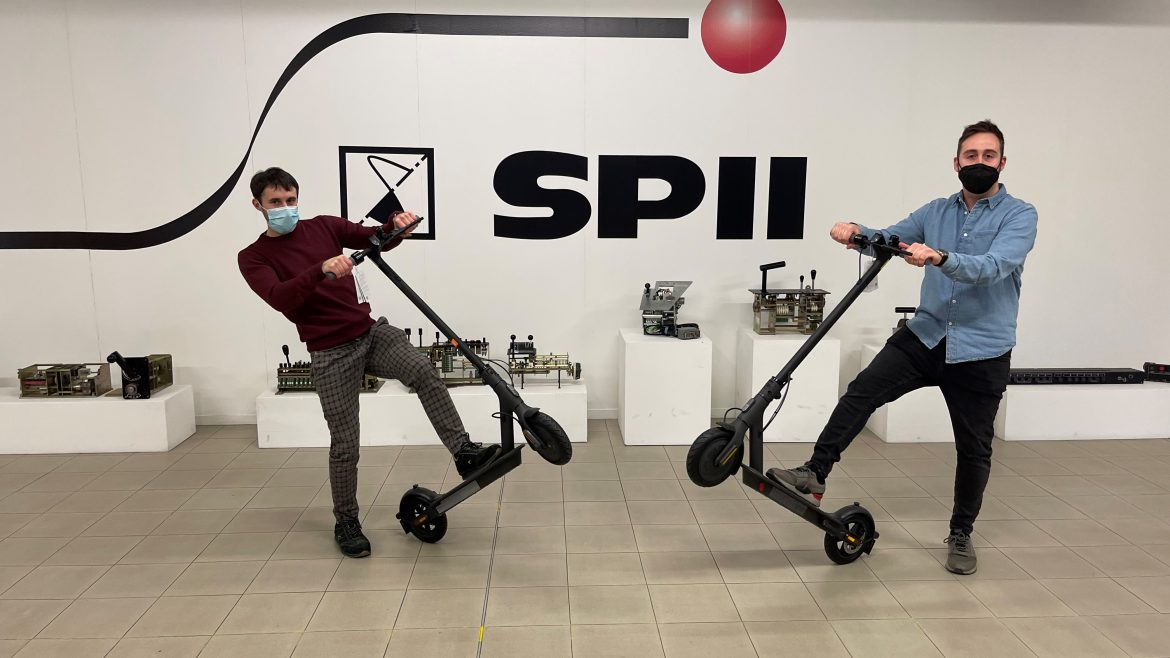
Our winners have been awarded a latest generation electric scooter.

The award was chosen thinking to environmental sustainability and electric mobility – in line with the growing role of the Schaltbau group in this area.

We thank the participants who got involved with determination and enthusiasm and the colleagues present at the award ceremony, for the joyfulness of this moment.

Let’s keep it up guys! #WhereverWeCan

Ps.: Being engineers, the winners had to assemble their gifts!

See you next time,
Simona Gianoli